

Who Holds the Pie? Power, Trust, and Decisionmaking in Leadership Transitions

by Andrés Marcuse-Gonzalez , NPAG
Complex internal dynamics between the board and staff are always present in leadership transitions. Naming and navigating power dynamics and ensuring that everyone feels valued, included, and engaged (especially when there is disagreement) is crucial to afford new leaders the mandate they need for success.
Choosing a Decision-Making Mode
At NPAG’s recent team retreat in Chicago, we took a break from eating deep dish pizza to learn together about decision modes, and how naming the mode for a given decision clarifies if, how, when, and to what end people will be consulted or participate in a decision. Specifically, we discussed The Management Center’s “The Modes of Decision-Making” and ways we bring each mode into how we engage with each other in different aspects of our work and in the search process. To summarize: the “mode” you select in a decision-making process helps prevent confusion, ensures all participants understand “the ask”, and leads to higher levels of engagement.
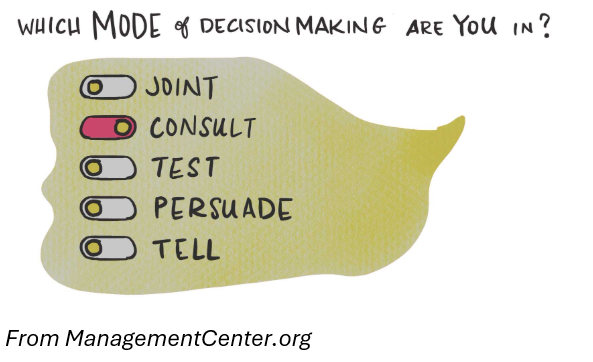
For example, you might say: “We invite staff members to nominate themselves or others to serve as staff representatives on the search committee. Next, I will select two nominees to serve, one from each team, factoring in your input.” Naming the mode, and what will happen next, and how input will be used serves an important purpose: to promote transparency, communicate decisions effectively, and ensure that all parties feel valued and included, even when decisions don’t reflect their first choice. In short: make sure everyone has a piece of the deep-dish pie.
Choosing (and Naming) Modes Builds Trust
Trust is the scaffolding upon which your leadership transition is built. The decision-making mode you adopt will either reinforce or erode that scaffolding and may have impacts that reverberate long after a new leader walks through the door.
Consider, for example, the difference between a board that actively solicits staff feedback throughout the process of hiring a new chief executive – at the outset, as the candidate profile is being determined; throughout, with regular updates within the bounds of confidentiality; and at the end, when they meet finalists and offer verbatim feedback to inform the decision of the Board and Search Committee – versus one that keeps that process entirely within the bounds of the Board with no meaningful staff input. In both cases, the governance model dictates that the hire is a Board-level decision, but in one, the work put into aligning Board and staff leads to greater clarity, a more holistic and comprehensive strategy for the search informed by all stakeholders, and ultimately a better-informed decision. Both boards may have made the same hire. But the staff experience, and their readiness to embrace that new leader will be vastly different. Confidence and trust are not established by outcomes alone, but through careful and transparent process.
This is especially important when power differentials are most pronounced. Boards hold fiduciary and governance authority. Staff hold institutional knowledge and operational continuity. Neither can afford to dismiss the other during a transition. Selecting a decision-making mode that is transparent about who holds authority while still creating meaningful space for staff voice bridges that gap with honesty, facilitates inclusion and belonging, and leads to better outcomes.
Practical Steps for Board-Staff Alignment
Getting this right requires intentional effort from both sides. Here are a few principles to guide the work:
Name the power dynamic early and directly: Acknowledge the structure, who the main decision-makers are, and how everyone’s voices will be incorporated and when.
Communicate, communicate, communicate: Leadership transitions create anxiety and differing levels of vulnerability. Communicating constantly, honestly, and in a way that invites feedback when appropriate goes a long way to mitigating stress for everyone involved.
Create structured, accountable feedback channels: town halls, surveys, listening-sessions, and even individual meetings are all meaningful avenues for staff to provide input. Follow-up is critical in all cases – when staff see how their input is processed and applied, their trust in the process (and thus in the next leader) is strengthened.
Setting the New Leader Up for Success
Ultimately, a healthy board-staff partnership during a leadership transition is not just about managing the process well; it is about paving the way for a new leader to join an organization that is ready to receive and move forward with them. When the staff feel valued and respected and the board feels supported and empowered, the incoming leader inherits an organization primed for momentum rather than one still processing the impacts of a poorly managed search.
Leadership transitions are, without question, among the most vulnerable inflection points an organization will face. But with the right frameworks, honest communication, and a genuine commitment to inclusion, they can also be among the most galvanizing. Choosing an intentional decision-making mode might slow things down compared to a faster but much less thoughtful process but, to paraphrase a well-known Chicago-based truant: A leadership transition moves pretty fast. If you don’t stop and consider which decision-making technique most accurately reflects your organizational values, you could miss an opportunity to strengthen culture and alignment.
